
Historic Blacksmiths

John Starkie Gardner
John Starkie Gardner (1845-1930) was born in Bayswater, London, the son of Cicely Starkie and John Edmund Gardner, a successful manufacturer of chandeliers and lamps. John lived with his affluent parents into his mid twenties, focusing on the advanced study of botany and geology—subjects on which he would also publish books. By 1878 Starkie Gardner had thrown himself into his new vocation of architectural ironwork, having executed a sophisticated and handsome pair of gates for the Worshipful Company of Leathersellers at their Hall on St. Helen’s Place, London. By 1882 he had established premises at 29 Albert Embankment, Lambeth, London.
In 1884, Gardner married Caroline Cubitt, a 33-year-old widow, and the daughter of architect Edwin Ward. The couple jointly ran Starkie Gardner and Company. Gardner began his association with the South Kensington Museum around this time, completing the Exhibition road gate in 1885 and numerous copies of masterworks for the collection including a replica of the Eleanor Grille in 1888 (the original made by Thomas de Leghton in 1294). Ironwork Volumes I & II were published by the South Kensington Museum in 1892 and 1896 respectively. In 1896 Gardner wrote a biography of Jean Tijou, accompanying a bicentennial reprinting of the master’s A New Booke of Drawings, establishing Gardner as an authority on the subject.
Two years later, in 1898, Gardner published Armor in England, another standard text on a related subject. His magnum opus was undoubtedly the 320 page tome, English Ironwork of the 17th & 18th Century. Published in 1911, it presumably took the better part of a decade to write. It was also a turbulent decade for Gardner. His wife, Caroline, petitioned for divorce and dissolved their partnership in 1900 when she found evidence of his infidelity. Gardner formed a new partnership with Lewis Boswell Inman Hamilton, and fortunes looked promising as the firm held a royal warrant as metalworkers to King Edward VII. But this success would be short lived—by 1912 Gardner had declared bankruptcy and dissolved the new partnership.
In 1914, Gardner married his longtime mistress, Alice Dring. He continued with ornamental ironwork, his second wife now running the company in partnership with Oswald Hasting Jaques. In 1920 the firm completed their most high profile commission, the Scottish National Memorial to King Edward VII entry gates and railings at the Palace of Holyroodhouse in Edinburgh, Scotland. Gardner’s second wife died in 1924, and Gardner himself passed in 1930. The firm continued on into the 1970s, though after World War II they had evolved into an engineering firm.
--------
Biography by Gabriel Craig. July 2025. An article about the writing and metalwork of John Starkie Gardner appears in the Fall 2025 issue of "The Anvil's Ring", published by the Artist Blacksmith Association of North America.
Additional credit to Terry Cavanaugh and Two Temple Place for writings which were referenced in the writing of the above biography.

Oscar Bach
Oscar Bruno Bach (1884-1957) was born in 1884 and educated in Germany, and from a very early age found great success as a metal designer. At 20 he had already completed a commission for Pope Leo XIII and designed the metalwork for Berlin’s City Hall. He arrived in the United States in 1912 and based his studio in New York. He worked on many major architectural commission alongside his development of a commercial studio that produced furniture, lighting, and house furnishings. Oscar Bach worked in ferrous and non-ferrous metals, and was much more amenable to casting than some of his contemporaries like Yellin, but he was equally capable with a hammer.

Edward F. Caldwell
Edward F. Caldwell (1851-1914) was one of the premier designers and manufacturers of electric light fixtures and decorative metalwork from the late 19th to the mid-20th centuries. While the works of his New York company were primarily focused on lighting, especially as a pioneer of electric lighting and electric lighting design, his firm E.F. Caldwell & Co., produced housewares, furniture, and architectural ironwork as well. When Caldwell died in 1914, he was succeeded by his partner Victor von Lossberg. The firm's commissions are so varied and numerous an abridged list of highlights would still fail to convey the scope and importance of his contributions to American Metalwork. Records of the firm can be found in the collection of the Cooper-Hewitt museum in New York.

Pierre Boulanger
Pierre Boulanger (1813-1891) was a French blacksmith closely associated with the French Gothic Revival and Eugene Viollet Le Duc. He was most active from 1845-1870 and completed new works and restorations for more than 55 ecclesiastical buildings in France, most notably the central portal door at Notre Dame de Paris, various projects at the Musee Cluny, and the Cathedral of Beauvais. He is widely considered to be one of the most virtuosic blacksmiths of his generation.
Cyril Colnik
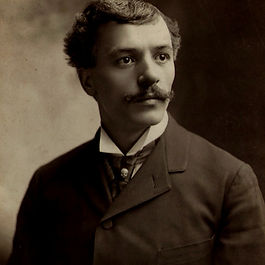
Cyril Colnik (1871-1958) was born in Austria. In his teens he began an apprenticeship studying in Graz and then Vienna. He settled in Munich and became part of the German ironworking team at 1893 World's Fair in Chicago. Colnik entered the grilled pictured below depicting Vulcan, for which he won a gold medal. After the exhibition Colnik moved to Milwaukee where he set up shop in 1894 and soon found brewer Frederick Pabst a willing Patron. Colnik would continuing working in, largely in the region until 1955. The Villa Terrece Museum in Milwaukee is a repository of several of his works.

Samuel Yellin
Samuel Yellin (1885-1940) is undisputedly the most important American blacksmith of the first half of the 20th century. He was born in 1885 in Mogolov, Russia, to Jewish parents Zacharis and Kate Yellin. At the age of 12 he was apprenticed to a local blacksmith. He would complete his apprenticeship fairly quickly and travel as a journeyman in Germany, Belgium, and England before immigrating to Philadelphia in 1906. Early on Yellin taught at the Pennsylvania Museum School and he opened his first shop in 1909 at the age of 24. Yellin was exceptionally gifted as an ironwork designer, skilled technical craftsman, historian, and publicist. This constellation of attributes led to his incredible success. Yellin prolifically executed commissions for public, private, and institutional clients from New York to San Francisco. Just a few short years after incorporating he had produced works for the likes of J.P. Morgan, Henry Clay Frick, and Cyrus Curtis.